

Namibia
Overview
History
Government
Economy

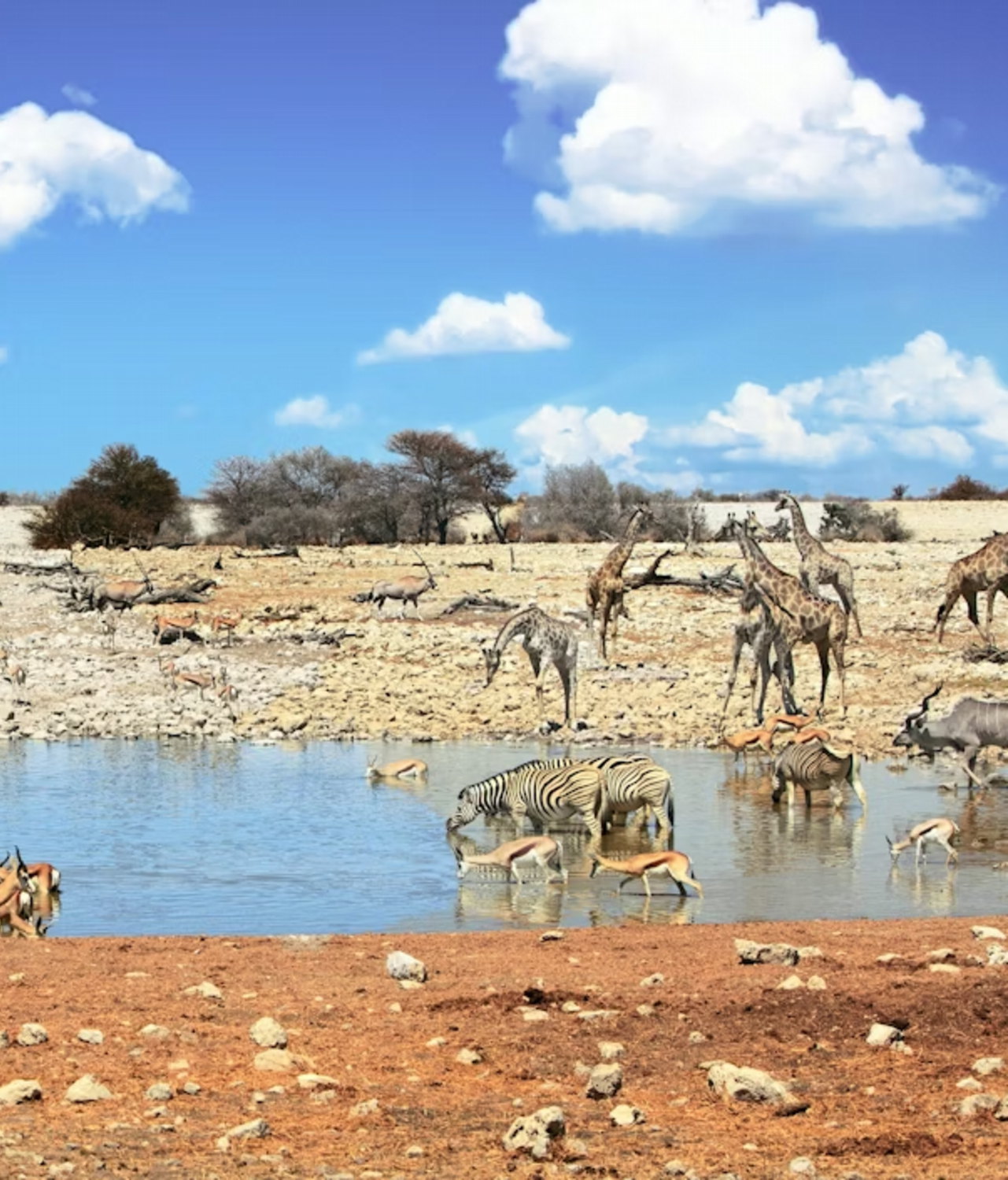
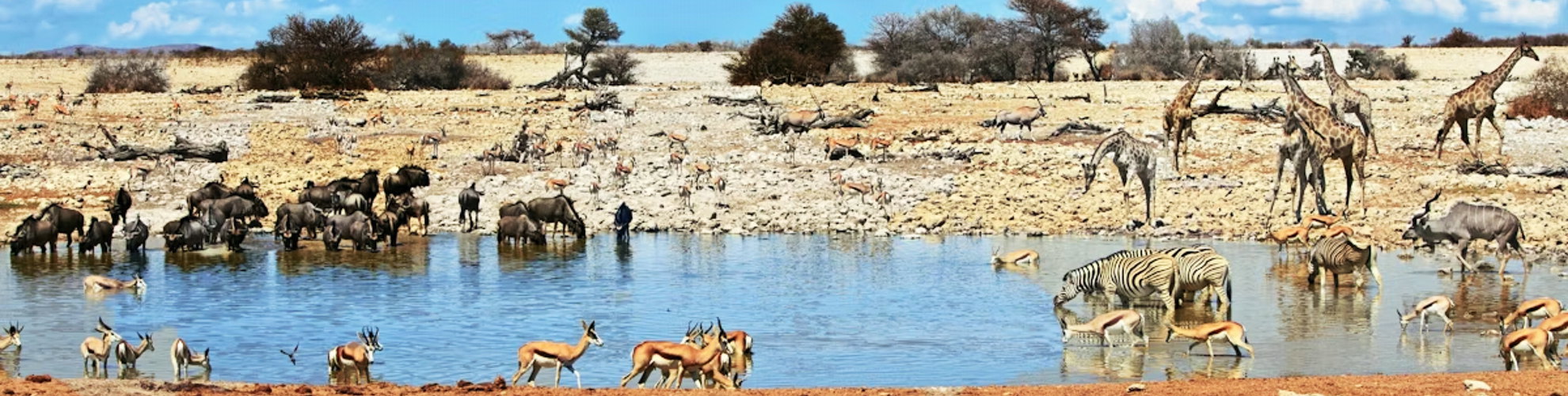
Namibia is a country of breathtaking contrasts, vast, rugged and unspoiled. Internationally Namibia is well known for its swirling golden dunes, shimmering ocean, pristine landscapes and abundant wild life. Along the Namibian coast lies the Namib Desert, a breathtakingly barren yet captivating sand landscape.
The hot desert coast meets the icy waters of the Atlantic Ocean often causing a blanket of fog. Unlike the east coast, the north of Namibia is rich in vegetation and fertile with a number of flowing rivers. Two of these, the Zambezi and the Okavango, rank among the great rivers of Africa. The strip is also the site of several game parks, which while not offering such an abundance of wildlife certainly provide spectacular scenery and relative solitude.


Amidst this seemingly untamed and wild African country, lies a country that is governed by a peaceful, stable and vibrant society. Namibia boasts with modern facilities, clean towns and a well-developed infrastructure. With more than 13 ethnic groups and languages, Namibia is a success story in a continent that is viewed with skepticism. It is here that you discover the beauty, diversity, remoteness and the wonder of Africa at its best.

Negotiations between the United Kingdom and Germany resulted in Germany’s annexation of the coastal region, excluding Walvis Bay. German colonial power was consolidated and prime grazing land passed to White control as a result of the Herero and Nama wars of 1904-08. German administration ended during World War I following South African occupation in 1915. Namibia was proclaimed a German protectorate in 1884. The conquest of Namibia (then was called South West Africa) by South African forces during World War 1 resulted in its subsequent administration by South Africa under a 1920 League of Nations mandate.
The South African government refused to give independence to the Namibian people, despite many resolutions by the United Nations for independence to the Namibian people. Therefore, Swapo (South-west Africa People’s Organization) liberation movement started the liberation war against the occupying South African forces. This resulted in the South African government to be forced to accept the 1989 implementation of the United Nations resolution 435 for free and fair elections to the Namibian people.

This followed 3 years of bilateral negotiations between the two governments and the establishment of a transitional Joint Administrative Authority (JAA) in November 1992 to administer the territory. The peaceful resolution of this territorial dispute, which dated back to 1878, was praised by the United States and the international community, as it fulfilled the provisions of UN Security Council 432 (1978) which declared Walvis Bay to be an integral part of Namibia on the 21st of march 1994.

The three branches of government are subject to checks and balances and provision is made for judicial review. The judicial structure in Namibia largely parallels that of South Africa and comprises a Supreme Court, the High Court, and lower courts. Roman-Dutch law has been the common law of the territory since 1919. The Executive branch comprises the Chief of State who is president of Namibia and the Cabinet which consists of members of the National Assembly.

In November 2004, the Founding Father announced his retirement and the Swapo Party democratically elected the Minister of Lands, Resettlement and Rehabilitation, Hifikepunye Pohamba to be the leader of the Swapo Party and candidate for the presidential elections. President Pohamba was elected by the Namibian people in free and fair democratic elections and inaugurated in March 2005 in conjunction with celebrations marking the country’s fifteenth anniversary.
As a republic, Namibia is also a secular state guaranteeing the freedom of religion and media. It is divided into 13 administrative regions including Caprivi, Erongo, Hardap, Karas, Khomas, Kunene, Ohangwena, Okavango, Omaheke, Omusati, Oshana, Oshikoto, and Otjozondjupa. The constitution provides for the private ownership of property and for human rights protections and states that Namibia should have a mixed economy and encourage foreign investment.
Namibia is a member state of the United Nations (UN), the Southern African Development Community (SADC), the African Union (AU) and the Commonwealth of Nations. Namibia became the 160th member of the United Nations on April 23, 1990, and the 50th member of the British Commonwealth upon independence.
President Netumbo Nandi-Ndaitwah

She was the first female presidential candidate for SWAPO (the South West Africa People's Organisation) in 2024. In 2017, Nandi-Ndaitwah was elected vice president of SWAPO, the first woman to serve in that position. Before entering the top leading position, Nandi-Ndaitwah served as the deputy prime minister of Namibia from 2015 to 2024, minister of International Relations and Cooperation from December 2012 to 2015, and as minister of Environment and Tourism from March 2010 to December 2012. She is a long-time member of the National Assembly.
Nandi-Ndaitwah became politically active as a teenager, joining SWAPO's ranks at the age of 14. She soon became the leader of SWAPO's Youth Movement organisation, fighting to end South Africa's occupation. Nandi-Ndaitwah soon became a target for the opposition, forcing her to go into hiding. Nandi-Ndaitwah went into exile in 1973 and joined SWAPO members in Zambia.
She worked at the SWAPO headquarters in Lusaka from 1973 to 1975 and attended a course at the Lenin Higher Komsomol School in the Soviet Union from 1975 until 1976. She graduated with a diploma in the work and practice of the communist youth movement. In 1987, she obtained a post-graduate diploma in public administration and management from the Glasgow College of Technology, in the United Kingdom, and 1988, a further post-graduate diploma in international relations from Keele University, also in the UK.
In 1989, Nandi-Ndaitwah obtained a master's degree in diplomatic studies, also from Keele University. After the 2024 November election, she was given an honorary Doctorate in diplomatic and public work by the University of Dar es Salaam.
During her inauguration speech in 2025, she pledged to focus on job creation, specifically targeting "500,000 new jobs" as a policy priority, with a key focus on agriculture, fishing, creative, and sports industries. In April 2025, Nandi-Ndaitwah announced that the government would provide free tertiary education in government schools beginning in 2026.

In recent years, mining has accounted for a substantial share of GDP (typically between 10% and 20%, depending on commodity cycles), while manufacturing contributes roughly 8–12%. Other important sectors include public administration, tourism, agriculture and financial services.
Namibia’s economy remains closely linked to that of South Africa due to historical ties, geographic proximity and strong trade integration. Namibia is one of Africa’s leading exporters of non-fuel minerals and is among the world’s largest producers of uranium. Rich offshore and alluvial diamond deposits make Namibia an important source of high-quality gem diamonds. In addition to diamonds and uranium, Namibia produces copper, gold, zinc, lead and other mineral resources.

Within SACU, goods produced in member states move tariff-free between countries. South Africa remains Namibia’s largest trading partner, with a significant share of Namibia’s imports originating there and many exports destined for or transiting through South Africa.
Outside of South Africa, the European Union remains an important market for Namibian exports. Namibia’s exports consist mainly of precious stones and diamonds, uranium, gold, copper, zinc, salt, meat, fish, oysters, grapes and leather products. Namibia has also benefited from preferential access to the United States market under the African Growth and Opportunity Act (AGOA), although the programme lapsed in September 2025 and is currently under temporary extension, with its long-term future uncertain. Apparel exports under AGOA have fluctuated in recent years.